OpenShell arrived with a 0.1.x release that adds a stable cadence, new isolation primitives, and expanded APIs. For teams that already run autonomous AI agents, the change matters because we can now grant agents the ability to read files, install packages, call APIs, and use credentials without exposing unrestricted access to our data, secrets, or network. The runtime’s kernel‑level enforcement and formal policy verification give us a concrete way to lock down agent behavior while still letting them operate autonomously.
Architecture
OpenShell’s architecture separates three core components:
- Gateway – the control plane that receives policy updates, orchestrates sandboxes, and mediates credential injection.
- Supervisor – monitors sandbox health and enforces runtime constraints.
- Sandbox – an isolated Linux environment (or macOS/WSL2) where each agent runs. The sandbox image is a minimal Ubuntu base by default, but we can customize it with GPU drivers or other runtimes.
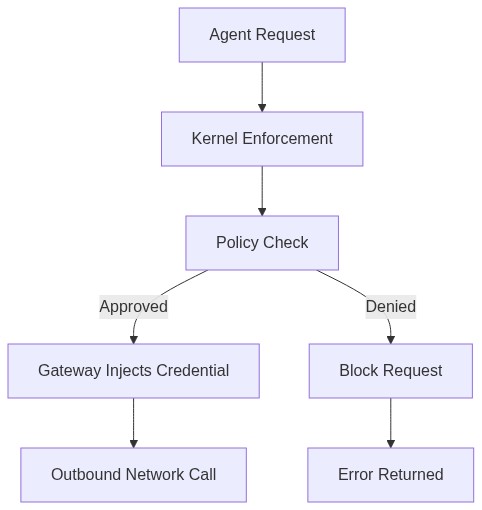
Agents never see raw credentials; the gateway injects them only when a request matches an approved policy. The design lets us run many sandboxes on a single host or across a Kubernetes cluster using the provided Helm chart. A CNI that enforces NetworkPolicy is required, ensuring that every outbound connection is filtered through OpenShell’s policy engine.
Security and Privacy Guarantees
OpenShell enforces two layers of protection:
- Kernel‑level enforcement – the Linux kernel is instrumented so that every file access, system call, and network connection is checked against the active policy. If a sandbox tries to open an unauthorized file or invoke a disallowed syscall, the kernel blocks the operation instantly.
- Formally verified policy changes – before a new policy is applied, OpenShell runs a formal verification step that flags risky extensions, such as granting access to a new host with credentials or enabling a new API method. Those changes pause for human review, preventing accidental privilege escalation.
Together, these mechanisms give us deterministic guarantees that agents cannot exfiltrate data or misuse secrets, even if the agent’s internal logic is compromised.
Integration with CI/CD Pipelines
OpenShell provides a CLI that can be scripted in any build environment. A typical pipeline adds three steps:
- Provision sandbox –
openshell sandbox create --name $SANDBOXruns inside a Docker or Podman container. - Deploy agent code – copy the built agent binary or container image into the sandbox.
- Apply policy – use
openshell policy applywith a JSON/YAML definition; the CLI returns a verification report that can fail the build if risky changes are detected.
Because the CLI is just a binary, we can invoke it from GitHub Actions, GitLab CI, or Azure Pipelines without additional services. The policy verification output integrates naturally with existing test reports, allowing us to gate deployments on security compliance.
Scalability for Large Agent Fleets
OpenShell’s sandbox model scales horizontally. Each sandbox is a lightweight container or VM, and the gateway can manage thousands of them when deployed behind a Kubernetes cluster. The Helm chart includes a replica‑set for the gateway, and the sandbox lifecycle API supports bulk creation and teardown. Network traffic is filtered by the CNI’s NetworkPolicy, which means the enforcement point stays at the cluster level rather than per‑sandbox, reducing overhead.
The runtime also supports GPU‑enabled sandboxes, letting us run compute‑heavy inference workloads without sacrificing isolation. By sharing the same host kernel, memory overhead stays modest compared with full virtual machines.
Cost Implications
OpenShell itself is open source under an Apache‑2.0 license, so there are no direct licensing fees. The primary costs are the compute resources required to run the sandboxes and any GPUs needed for inference. Because sandboxes are container‑based, we can pack many agents onto a single VM, optimizing utilization. The ability to enforce strict policies also reduces the risk of data‑leak incidents, which can translate into lower operational and compliance expenses.
Real‑World Use Cases
- Code‑generation assistants – a demo ships with OpenShell that runs OpenCode against a free OpenRouter model. The agent requests network access only when it needs to fetch a library, and the policy reviewer approves the new host before credentials are injected.
- Enterprise data pipelines – teams can wrap existing ETL scripts in a sandbox, declare file‑system and network boundaries, and let the formal verifier ensure no accidental data export.
- Secure inference services – by placing inference providers behind the gateway, we can expose model endpoints to agents while guaranteeing that credentials are only sent to approved hosts.
These examples show that OpenShell fits both experimental prototypes and production‑grade deployments where security and auditability are non‑negotiable.
Recommendation by Use Case
- Rapid prototyping – use the local CLI installer on Linux or macOS, create a single sandbox, and iterate on policies with the advisor tool.
- Enterprise CI/CD – embed the CLI steps in your pipeline, enforce formal verification, and deploy the gateway with Helm for multi‑team governance.
- Massive fleet – run the gateway in a Kubernetes cluster, leverage CNI
NetworkPolicyfor cluster‑wide enforcement, and scale sandboxes horizontally with replica sets.
Choosing the right deployment pattern depends on the size of your agent fleet and the strictness of your compliance requirements, but OpenShell gives us a single runtime that can grow with us.
Takeaway
OpenShell gives developers a concrete, open‑source way to give autonomous agents the capabilities they need while keeping data, secrets, and network access under strict, verifiable control. By integrating its CLI into CI/CD, leveraging Kubernetes for scale, and relying on kernel‑level sandboxing, teams can move from ad‑hoc scripts to production‑grade agent fleets without sacrificing security or incurring licensing overhead.