

What Changed and Why It Matters Now
We announced Gemini 4 Carbon on Oct 28, 2026 as the next‑frontier model in the Gemini family. It is positioned as the strongest model to date, combining state‑of‑the‑art cybersecurity performance with the ability to sustain long‑horizon, agentic workflows. For developers building automation pipelines, the shift means a single model that can both generate secure code and persist through multi‑day engineering loops without the degradation that older models exhibit.
Performance Benchmarks
- Artificial Analysis Intelligence Index v5.0 – Carbon ranks #1 with a score of 59, outpacing all contemporaries.
- SEC‑bench Pro – 88.2% success at autonomously finding real‑world software vulnerabilities.
- ExploitGym – 54.8% on exploitation, setting a new state‑of‑the‑art.
- CWE‑bench – 71.0% on patch generation, turning validated findings into working fixes.
- WebDev Arena – Gains +89 elo points to land at #4 (1768) for full‑stack web development tasks.
- Internal secure‑code uplift – More than 2× improvement over Gemini 4 Argon, with reduced misalignment and fabrication rates reported by internal teams.
These numbers demonstrate that Carbon is not just a marginal upgrade; it delivers measurable gains across the entire cybersecurity defense lifecycle—detection, validation, and remediation—while also raising the bar for coding and agentic tasks.
Carbon Efficiency and Cost Structure
Cost efficiency is a practical concern for any automation pipeline. Gemini 4 Carbon launches at the same introductory price as its predecessor Argon: $2 per million input tokens and $10 per million output tokens. Cached input tokens are priced at 95 % off the input token rate, making repeated reads of static data inexpensive. The pricing model aligns with long‑running workflows, where the same codebase may be queried repeatedly during iterative debugging or patch generation.
New Feature Set
- Long‑horizon agentic capability – Designed to run for days, Carbon can persist through dead ends and tackle multi‑step engineering problems such as root‑causing subtle bugs across large codebases.
- Multimodal understanding – Extends beyond text to handle visual and code artifacts, improving full‑stack web development outputs.
- Improved coding quality – Gains in web development benchmarks and internal secure‑code generation indicate higher fidelity in generated artifacts.
- Enhanced scientific reasoning – Targeted improvements in scientific tasks broaden applicability beyond pure software engineering.
Safety Mechanisms
Gemini 4 Carbon inherits the multi‑layered safety stack of Argon and adds several refinements:
- Model training with alignment focus – Additional alignment data reduces the model’s propensity for shortcuts and loophole exploitation.
- Real‑time misuse defenses – Built‑in checks monitor for prompt‑injection attempts and other adversarial patterns.
- Chain‑of‑thought monitoring – Continuous oversight of reasoning paths helps catch hallucinations before they surface in output.
- Guardrails testing – The model is currently undergoing voluntary pre‑release testing with the U.S. government and will be phased through the Fairwind Program before broader availability.
These mechanisms aim to keep the model’s powerful capabilities in check, especially when deployed in security‑sensitive automation pipelines.
Integration Tips for Automation Pipelines
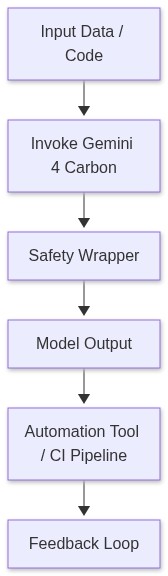
When wiring Gemini 4 Carbon into CI/CD, incident response, or continuous security testing, consider the following practical steps:
- Cache static inputs – Leverage the 95 % discount on cached input tokens for code repositories or configuration files that rarely change.
- Apply safety wrappers – Route all model calls through a lightweight proxy that enforces the real‑time misuse defenses and validates chain‑of‑thought outputs before they reach downstream tools.
- Chunk long‑running tasks – Break multi‑day workflows into manageable token windows, persisting intermediate state in a secure datastore to avoid token limits.
- Monitor benchmark metrics – Track success rates on internal vulnerability detection and patch generation to ensure the model meets your organization’s security SLAs.
- Gradual rollout – Start with a trusted subset of security engineers via the Fairwind Program, collect feedback, and expand access as guardrails prove effective.
Recommendation by Use Case
- Security‑focused automation – Choose Carbon for any pipeline that requires autonomous vulnerability discovery, exploitation validation, or automated patch generation. Its benchmark leadership (SEC‑bench Pro, ExploitGym, CWE‑bench) directly translates to higher detection and remediation confidence.
- Long‑running code synthesis – For projects that involve extensive refactoring or multi‑step debugging across large codebases, Carbon’s ability to sustain agentic loops for days reduces the need for manual orchestration.
- Cost‑sensitive web development – The cached token discount makes repeated web‑dev queries economical, while the WebDev Arena ranking signals higher quality outputs.
Takeaway for Teams Building Software
Gemini 4 Carbon consolidates top‑tier cybersecurity performance, long‑horizon reasoning, and a predictable pricing model into a single LLM. By embedding its safety stack and leveraging token‑caching, development teams can automate secure code generation and vulnerability remediation at scale, while keeping costs and risk under control.
[[IMG_2]]