

Why GPT‑6.2 matters now
OpenAI just announced two new variants of its flagship model: GPT‑6.2 Astra for frontier, high‑complexity work and GPT‑6.2 Sol for everyday automation. Both claim better results with fewer output tokens, meaning we can push more logic through the same usage limits. For teams that already run multi‑step agents or generate code, the cost‑to‑performance ratio shift is immediate – Astra delivers a new quality bar on professional tasks, while Sol gives us a cheaper, still‑smart default for routine pipelines.
Integration strategies
When we add a new model to an existing stack the first questions are about API economics and token handling. Astra’s pricing is transparent: $8 / M input tokens, $0.40 / M cached input, and $40 / M output tokens, all 20 % lower than the previous GPT‑6 Astra and with a 60 % discount on cached input. Sol keeps the same token rates as GPT‑6.1 Sol, so no price surprise there.
Steps to integrate
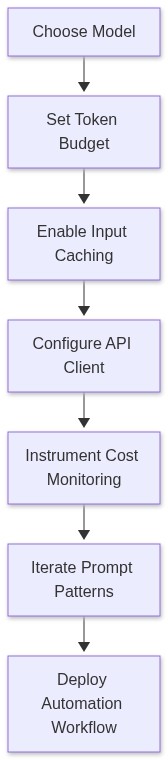
- Pick the right model for the job – Use Astra for tasks that need high‑fidelity code, complex document generation, or scientific workflows. Use Sol for multistep agentic pipelines, routine summarisation, or internal tooling.
- Set token budgets – Because Astra’s output token usage is lower, you can allocate tighter budgets for long‑form outputs without hitting limits.
- Enable input caching – The 60 % discount on cached input makes it worthwhile to cache static prompts (e.g., policy documents, schema definitions) and reuse them across calls.
- Configure the client – Most SDKs let you specify
model: gpt-6.2-astrorgpt-6.2-sol. Pass the pricing overrides if you need custom billing reports. - Instrument cost monitoring – Track input, cached input, and output token counts per request. Compare against the benchmark cost ratios (Astra delivers 5.2 pts higher on Agents’ Last Exam at < ⅓ the cost of GPT‑6 Astra).
- Iterate prompt patterns – Astra follows templates closely; feed it well‑structured examples of slides, spreadsheets, or code snippets. Sol benefits from concise, conversational prompts.
Performance benchmarks you can rely on
OpenAI’s own evaluations give us concrete numbers to base capacity planning on:
- Agents’ Last Exam – Astra scores 5.2 points higher than GPT‑6 Astra while using less than a third of the cost, and 5.5 points ahead of Claude Fable 5.2 at just 5 % of that cost.
- Terminal‑Bench‑Science 0.1 – Astra beats GPT‑6 Astra by 9 percentage points, again at under one‑third the cost, making it the top choice for scientific terminal workflows.
- Cognition’s FrontierCode 2.0 – Sol trails Astra by only 0.5 points but runs at roughly one‑fifth the cost when both are maxed out.
- LifeVal – Sol outperforms GPT‑6 Astra at about one‑seventh the cost on everyday, user‑centric tasks.
- Harvey LAB‑AA v1.1 (legal) – Astra more than doubles Claude Fable 5.2’s pass rate while costing about one‑sixth as much.
- GDPval v2 (long‑horizon knowledge work) – Astra improves 6.2 percentage points over GPT‑6 Astra and uses 22 % fewer output tokens; Sol adds a 5.3‑point lift over GPT‑6.1 Sol.
- AA‑AnalystAgent (financial spreadsheets) – Astra answers 62.5 % of questions correctly across five independent attempts.
These numbers tell a clear story: Astra gives you frontier performance for a fraction of the price, and Sol delivers near‑Astra quality for routine automation at a fifth‑to‑seventh‑of‑the‑cost scale.
Best practices for real‑world automation workflows
- Leverage caching aggressively – With $0.40 / M cached input, storing static context (e.g., regulatory templates, code style guides) yields huge savings.
- Batch token‑heavy operations – Group spreadsheet calculations or document generation into a single request to amortise the fixed input cost.
- Use model‑specific prompting – Astra responds best to detailed, domain‑specific templates (e.g., legal briefs, design specs). Sol thrives with brief, task‑oriented prompts.
- Monitor token‑to‑accuracy trade‑offs – The benchmarks show Astra can achieve higher scores with fewer output tokens. Experiment with
max_tokenssettings to find the sweet spot for your SLA. - Fallback strategies – For edge cases where Astra’s cost is still high, start with Sol and fall back to Astra only when the confidence score drops below a threshold.
- Security and privacy – Both models run via the same API, so existing data‑handling policies apply. Keep sensitive payloads encrypted before sending and consider on‑premise caching for compliance.
Recommendation by use case
- Complex code generation, scientific research, high‑stakes legal drafting – Choose GPT‑6.2 Astra. The benchmarks (Agents’ Last Exam, Terminal‑Bench‑Science, Harvey LAB‑AA) prove it outperforms peers at a fraction of the cost.
- Multistep agents, internal tooling, routine content creation – GPT‑6.2 Sol is the pragmatic default. It matches Astra within a point on FrontierCode 2.0 while costing about one‑fifth as much.
- Hybrid pipelines – Start with Sol for speed, then invoke Astra for the final polishing step on outputs that need professional quality.
Takeaway for teams building software
GPT‑6.2 Astra and Sol give us a new cost‑performance frontier. By aligning model choice with task complexity, caching static prompts, and instrumenting token usage, we can squeeze more automation out of every dollar. The benchmarks are not just marketing – they provide a quantitative basis for budgeting and SLA planning. Adopt the split‑model strategy now and let your agents run faster, cheaper, and with higher fidelity.