

The Decision Nobody Wants to Make
Every maturing engineering organization eventually faces a painful question: Do we modernize what we have, or build something new? Your backend system is getting slower, costs are climbing, and deployment friction is grinding your team to a halt. Yet the codebase still powers revenue. The stakes are high, the timeline is unclear, and the outcome depends entirely on decisions made before you fully understand the problem.
We're not going to tell you that one answer is always right. Instead, we'll walk you through the framework we've used to make this decision repeatedly, across different scales and technical contexts. This isn't about philosophy. It's about the specific calculations that matter.
Technical Debt Assessment: Quantify Before You Decide
Technical debt isn't a feeling—it's a measurable drag on velocity and reliability. Before comparing refactor against rewrite, you need actual numbers.
Start with deployment frequency and cycle time. How long does a code change take to reach production? If you're measuring in days or weeks for a simple feature, that's a signal. Pull your git history from the last quarter: count commits, measure time-to-merge for routine changes, and document blockers. Are code review cycles lengthy because of coupling and cognitive load? That's real cost.
Next, measure your defect escape rate. What percentage of bugs make it to production before internal testing catches them? Correlate this to code complexity. Use a static analysis tool (Sonarqube, Metrics for Python, or similar) to identify high-complexity modules. If your most complex 10% of modules generate 60% of defects, that concentration matters.
Document system coupling. Pick a routine feature change—say, adding a new field to a user model. How many code paths must you touch? How many databases, caches, or external services must you modify? If that single change required edits in twelve places, you have coupling that will doom both refactoring and the status quo.
Capture performance degradation over time. Pull metrics from the past 18 months: P99 latency, error rates, resource utilization under standard load. Did latency double while request volume only grew 40%? That's a sign your architecture is hitting walls that code optimization alone won't fix.
Finally, measure support burden. How much of your on-call rotation is spent fighting fires in specific subsystems? If 30% of incidents originate in one component, and that component is also your hardest to modify, the business cost is compounding.
Performance Bottlenecks: Find the Actual Constraint
Many organizations rewrite to fix performance problems that don't actually come from the architecture. This is expensive and frequently wrong.
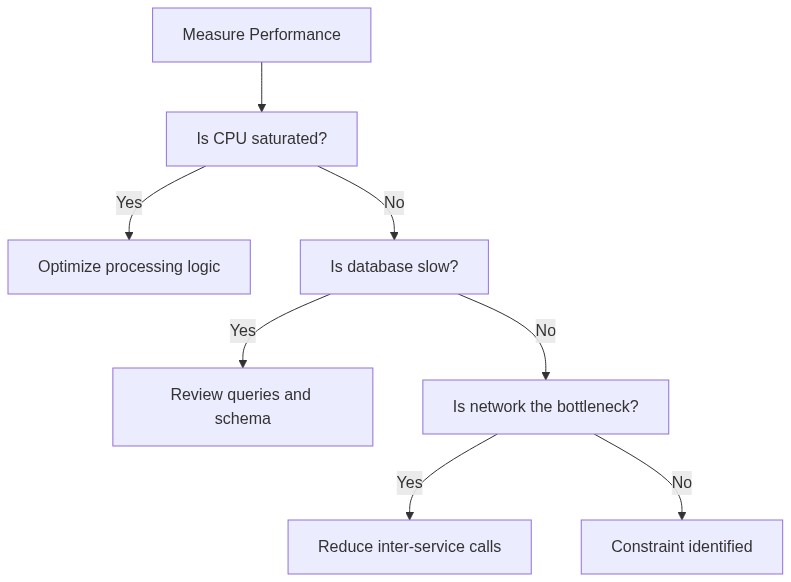
Use profiling data, not assumptions. Run production traces for a full week. Identify the request paths that consume the most CPU, I/O, or memory. Don't guess. Tools like Datadog, New Relic, or open-source solutions (Jaeger, Prometheus) will show you where the time actually goes.
Separate architectural constraints from implementation inefficiencies. If your database is slow because of missing indexes and poorly written queries, that's a tuning problem, not necessarily an architecture problem. Indexes are trivial to add; rewrites are not. However, if your database is slow because you're running 50 sequential queries per request and your schema forces denormalization nightmares, the architecture itself is the constraint.
Look at resource saturation patterns. If CPU maxes out before your database connection pool, you need processing optimization. If your database saturates first, you need data access patterns changed or data layer scaled. If network bandwidth becomes the limit, you need less chattiness between services. Each tells a different story about whether refactoring specific layers can help.
Evaluate third-party dependency lock-in. Are you stuck on an unsupported library version because updating would require rewriting 30% of your codebase? That's technical debt. Can you patch it incrementally without rewriting? Probably yes. Does it block scalability? Maybe not—it blocks maintainability and future hiring.
Migration Risk Evaluation: What Can You Afford to Lose?
Refactoring keeps existing systems running while you improve them. Rewriting replaces the system entirely. One is a controlled upgrade; the other is a fork in the road where you must commit fully.
Map your system's dependencies on existing behavior. Which features or data characteristics are implicit? If your API's response format is consumed by ten different internal teams, ten mobile app versions, and five third-party integrations, changing it is a coordination nightmare. If it's consumed by one internal team that you control, the risk is lower.
Estimate your data migration scope. How much data must move cleanly? How much has inconsistencies that need cleanup? A clean, well-structured dataset can be migrated in weeks. A dataset with duplicate records, orphaned references, and mixed data types in the same column can take months—if it's even possible without losing information.
Define your behavioral compatibility requirements. Can your new system accept degraded performance for a transition period? Can you tolerate brief inconsistencies between old and new? If you must maintain 100% uptime and perfect consistency during migration, you've drastically reduced which options are viable. Strangler patterns, dual-write periods, and shadow traffic testing all become necessary—they add months to a rewrite timeline.
Quantify your blast radius. If the backend system fails during refactoring, what breaks? Revenue-critical payment processing? Critical infrastructure? Logging and monitoring? Customer-facing product? Risk scales with impact. A rewrite of an internal reporting system is lower-risk than rewriting payment processing.
Team Capacity and Timeline Reality
This is where most estimates fail. Organizations vastly underestimate rewrite timelines and overestimate what their team can actually execute while maintaining production systems.
Count your available capacity. If your team is 8 people and 6 are on on-call rotation for production, you have 2 people for new work. Can 2 people rewrite a backend system? No. Can 2 people refactor incrementally while others keep production stable? Maybe. This math matters.
Factor in domain knowledge loss. People leave. If your most experienced engineer retires and they held all the architecture knowledge, your team's capacity to execute complex changes drops. Refactoring is more forgiving of turnover because existing code still works. Rewrites require all knowledge to be documented and transferred.
Consider context-switching cost. If your team must maintain production while refactoring, they'll spend 20-30% of time switching contexts. A "3-month refactor" for a team of 4 becomes 4-5 months in reality. A rewrite that requires a dedicated team can potentially move faster—if you can actually dedicate one.
Plan for learning curves. If you're rewriting in a new technology stack, team members are slower initially. Budget 20-30% productivity loss for the first two months, 10-15% for the next four. That's not laziness; it's reality.
Define your contingency buffer. Estimate your timeline. Add 50%. That's not pessimism—that's experience. Refactors often uncover hidden complexity. Rewrites always involve surprises. If your business can't absorb a 50% schedule slip, you probably can't afford a rewrite.
Cost-Benefit Analysis: The Math That Matters
Refactoring and rewriting have different cost structures. Refactoring is distributed, ongoing cost. Rewriting is concentrated, upfront cost with ongoing payoff.
[[IMG_2]]
Calculate your current-state cost. What does it cost to run your system annually? Infrastructure, labor (on-call burden, maintenance time, context-switching), opportunity cost (features you can't build because you're fighting fires). Sum it honestly.
Estimate refactor cost and timeline. Identify the specific pain points—coupling, performance, scaling limits. Estimate effort to address each one. Add time for testing, gradual deployment, and unexpected issues. Be honest about whether you have team capacity to do this without hiring.
Estimate rewrite cost and timeline. How long to design the new system? How long to build? How long to migrate data and traffic? How long to stabilize? This is typically 1.5x to 3x longer than you initially think. Factor in hiring if you don't have dedicated capacity.
Calculate payoff. How much faster will the refactored system be? How much will on-call burden decrease? How much will deployment speed improve? If payoff is 30% cost reduction and 2x faster deployment, calculate the business value over 3 and 5 years.
Model the risk-adjusted timeline. If a rewrite has an 80% chance of taking 12 months and a 20% chance of taking 18 months, your expected timeline is 12.8 months. But your worst-case is 18. Can your business survive that scenario?
Compare breakeven points. If a refactor costs $400K in labor, saves $200K annually, breakeven is 2 years. If a rewrite costs $800K, saves $350K annually, breakeven is 2.3 years. But if the refactor buys you 3 years before you'd need to rewrite anyway, the refactor is better business. If the rewrite enables new products that generate revenue, the calculus changes entirely.
The Practical Framework
Here's how we actually make this decision:
If technical debt is localized to one or two components, bottlenecks are fixable with refactoring, your team has capacity, and migration risk is low, refactor incrementally.
If technical debt is pervasive, your architecture fundamentally constrains scaling, you have dedicated team capacity, data migration is manageable, and the business can tolerate concentrated upfront cost, rewrite.
If you're between these, consider phased rewrites: identify which components are salvageable and which must be rebuilt, then execute incrementally. This is harder to manage but often lower risk than binary choices.
Most organizations benefit from a hybrid approach: refactor what's salvageable, rewrite what isn't, and plan your next decision point for 3-5 years forward. No decision is permanent. Your job is to make the best move given current constraints and buy runway for the next engineering team to make better decisions than you can today.