

The Strategic View: Debt as a Business Tool
We've inherited the term "technical debt" from Ward Cunningham, and it carries moral baggage. Engineers talk about it the way accountants speak of junk bonds—something to minimize, something that accrues interest, something that eventually collapses if left unchecked. But that framing misses a critical insight: not all debt is created equal, and sometimes borrowing against architectural cleanliness is the smartest bet a team can make.
The question isn't whether to carry technical debt. Every live product carries it. The real question is whether you're accumulating debt strategically—deliberately, with eyes open to the cost, in service of a measurable business outcome—or accidentally, through shortcuts that compound in ways you didn't anticipate.
When Stripe launched, they chose to build their initial payment processing on a monolithic codebase that would have made architectural purists wince. They optimized for speed to market and API elegance, deferring the infrastructure complexity that might have consumed six months. That tradeoff—a specific, bounded form of technical debt—allowed them to ship faster and validate their core insight: that payment processing could be developer-friendly.
They didn't ignore the debt. They measured it, tracked it, and paid it down methodically once the business model was validated. But the early accumulation wasn't a mistake; it was a deliberate choice with clear business logic behind it.
Categorizing Debt: Not All Shortcuts Are Equal
The framework breaks down like this: some technical debt is strategic, some is tactical, and some is corrosive.
Strategic debt is accumulated to achieve a specific, time-bound business goal. You're shortcutting process or architectural completeness to ship a feature, validate a market hypothesis, or reach a scaling milestone. The key characteristic: you have a clear point at which you'll address it. Stripe's monolith decision fits here—they had a timeline for when they'd break it apart, and they did.
Tactical debt emerges from constraints you can't control: limited headcount, third-party tools that don't fully integrate, compliance requirements that force workarounds. You're not choosing the shortcut; you're choosing to live with it temporarily while you build the right solution. Tactical debt often disguises itself as strategic debt, so the discipline is in being honest about which is which.
Corrosive debt is what happens when strategic becomes chronic. It's shortcuts you no longer remember taking, workarounds that have become the normal path, or architectural decisions that made sense for version 1.0 and now prevent version 2.0 entirely. Corrosive debt doesn't just slow you down—it biases your team toward further shortcuts because "this is how we do things here."
The framework surfaces one hard truth: you can't manage debt you can't name.
Measuring the ROI of Debt
Traditional accounting has a clean metric for debt: the interest rate. Engineering doesn't. But we can construct useful proxies.
Velocity cost: How much slower does feature development become per month of accumulated debt in a given system? This isn't abstract; it's measurable. Track story points completed per sprint, plot it over time, and correlate it against the complexity of your codebase or the volume of known workarounds in a module. When velocity drops 5% per quarter in a critical path, you have a number.
Onboarding cost: How long does it take a new engineer to be productive in a system heavy with debt versus one that's been recently refactored? Measure: weeks to first solo PR, ramp time to ownership, and the density of context-switching between codebases.
Incident cost: Track the correlation between systems with high technical debt and incident severity. If a debt-heavy module causes P1 outages twice as often as a clean module, that's a measurable drag.
Opportunity cost: For strategic debt especially, quantify what you gained. If you shipped a feature three months early by accepting architectural corners, and that enabled $2M in ARR, the debt was worth it—and now you have a number justifying the refactor budget.
None of these are perfect, but together they build a case for debt paydown in terms the business understands: velocity loss, incident expense, and opportunity capture.
The Decision Framework: When to Accumulate
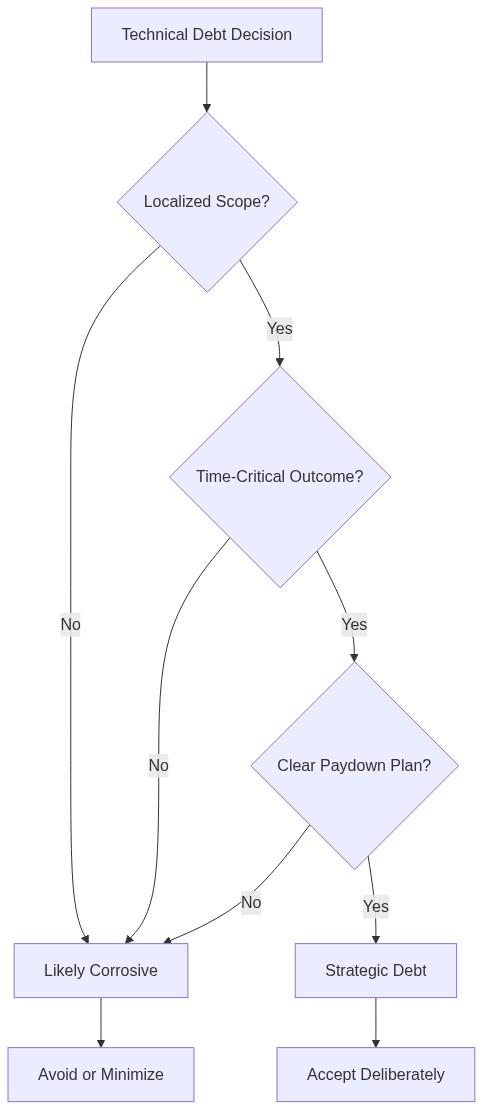
Accept strategic debt when all three are true:
- Time-critical business outcome: You need the code shipped within a defined window to hit a market window, funding milestone, or integration deadline. If you have two years, you have time to do it right.
- Bounded scope: The debt is localized to a specific system or feature. You're not burning a fundamental architectural assumption that will poison every future decision. If you're cutting corners on your auth layer, you've failed this test; if you're hand-rolling a reporting query that should eventually be an ETL, you've passed it.
- Clear paydown plan: You've identified explicitly when and how you'll address the debt. "Eventually refactor" is not a plan. "When Series B closes, we hire two backend engineers to rebuild the monolith as microservices" is a plan.
If you can't tick all three boxes, you're likely accumulating corrosive debt, not strategic debt.
The Decision Framework: When to Pay Down
Initiate debt paydown when any of these become true:
- Velocity has demonstrably declined: You've measured the slowdown, it's material (>10% per quarter), and the debt is a direct cause rather than a symptom of outgrowing your team's skills.
- New business direction requires architectural change: You're expanding into markets or capabilities that the debt-carrying system can't support without fundamental rework. Paying down now is cheaper than paying down later after the architecture is even more locked in.
- Incident density has climbed: If debt-heavy systems are now the source of your most frequent or severe incidents, the cost of carrying that debt exceeds the cost of addressing it.
- Onboarding is becoming a bottleneck: New hires spend disproportionate time in debt-heavy codebases, or experienced engineers are leaving because the codebase frustrates them. This is a people cost, and it compounds.
Pay down surgically: refactor the specific debt-bearing system while leaving the rest of the codebase untouched. The worst approach is a full rewrite—the second-worst is deciding to "modernize everything while we're at it."
Case Study: Discord's Refactoring Choice
Discord scaled explosively after 2015, and the architecture that supported 10,000 concurrent users started to creak under 1M+. They had accumulated debt around message handling and caching. The decision: they could limp forward, patching and optimizing, or they could rebuild the message pipeline.
Their choice was disciplined paydown. They didn't rebuild the entire platform; they rebuilt the specific bottleneck. The tradeoff: three months of reduced velocity during the migration. The outcome: a 10x improvement in message throughput per server and a platform that could scale to 10M+ concurrent users. The debt paydown was justified by a measurable capability unlock.
What made it work: they had clear metrics for why the paydown was necessary (message delivery latency, server capacity), a bounded scope (one system), and a team deep enough to execute without external help.
When to Refactor vs. Rebuild
Refactor when: the underlying logic is sound, but the implementation is inefficient or poorly structured; the debt is localized; and the business can tolerate 4-8 weeks of reduced velocity in that system.
Rebuild when: the underlying logic itself has become a constraint; the debt has metastasized across multiple systems; or the refactor timeline approaches the rebuild timeline anyway due to interconnections.
The temptation is always toward "one more refactor." Resist it. Sometimes paying down technical debt means writing new code, not editing old code.
Living with Debt Without Drowning in It
Final principle: the teams that manage technical debt best aren't the teams that avoid it entirely. They're the teams that treat debt decisions as business decisions, made with the same rigor as capital allocation.
Embrace strategic debt when the business case is clear. Track it relentlessly. Pay it down on schedule. Refuse corrosive debt—the kind you accumulate out of habit rather than intent.
Technical debt isn't a moral failing; it's a financial instrument. Use it like one.