

What Technical Debt Actually Costs You
We've all seen it: a codebase where adding a simple feature takes three sprints because the architecture was built five years ago before anyone knew what the product would become. The fix seems obvious in hindsight—refactor the payment module, decouple the data layer, standardize logging. But the cost isn't always measured in hours. It compounds.
Technical debt management isn't about achieving a perfect codebase. It's about making deliberate trade-offs—understanding when to pay down debt and when the business accepts interest payments in the form of slower feature velocity, higher defect rates, or increased operational overhead.
For CTOs and engineering leaders evaluating external teams, this clarity matters deeply. A build partner who frames technical debt as a quantifiable problem (not a moral failing) signals they'll make transparent decisions about your codebase, not hide behind "refactoring for months."
Measuring Technical Debt: Moving Beyond Gut Feel
Before you can manage debt, you need to see it. We recommend a multi-layer measurement approach:
Code-level metrics capture the immediate symptoms. Cyclomatic complexity, test coverage gaps, dependency violations—these are detectable automatically. Tools scan for patterns: functions exceeding 200 lines, circular imports, missing error handling. The data is objective. A sprawling payment service with 12 branches per method and 40% test coverage has measurable debt.
But code metrics alone miss the bigger picture. A module can be perfectly clean yet live on a deprecated framework nobody knows anymore. That's a different kind of debt: knowledge debt. It lives in how many people understand a system, whether documentation exists, and how long onboarding takes.
Development friction metrics reveal the human cost. Track: time-to-first-merge for features in different areas of the codebase, incident response time by service, rollback frequency, and the percentage of sprint capacity consumed by bug fixes versus planned work. When 35% of your backend team's time goes to firefighting in the legacy payment system, that's debt with a price tag.
Finally, measure operational debt: infrastructure patterns that strain reliability. Missing health checks, manual deployment steps, lack of observability, databases without backups. These don't prevent shipping; they prevent sleeping.
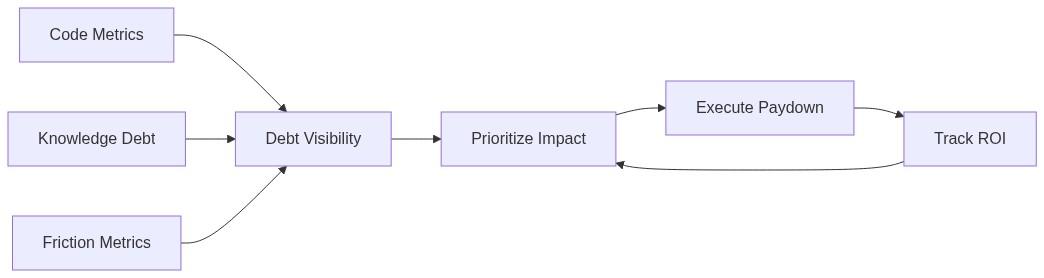
Once you're measuring, set baselines. You might discover that your monolith has 1,200 code smells, 58% test coverage, and onboarding takes 10 days. These become your north star metrics. Your goal isn't perfection—it's direction. Reducing code smells by 20% over two quarters while maintaining coverage signals progress.
Prioritizing: What to Pay Down When
Not all debt is equal. A tangle of conditional logic in an internal admin tool is annoying; a tangle in your authentication service is a liability.
We prioritize using a simple matrix:
Impact × Frequency. If a piece of code breaks often and affects many users (or many features), it bubbles up. A flaky OAuth integration that fires every two weeks and blocks five teams? Pay that down first. A convoluted batch job that runs once monthly and one person understands? Lower priority—still track it, but don't starve feature work.
Onboarding cost. When new engineers join, where do they get stuck? Where do they break things? A sprawling domain model that takes two weeks to grasp creates ongoing friction. Every hire compounds the cost. If refactoring this takes two sprints but reduces onboarding from 10 days to 5, the math is clear after three new hires.
Blocking future work. Is debt preventing you from adopting microservices, moving to a new database, or scaling to your next 10M users? If the roadmap requires an architecture shift and the current code can't support it, debt repayment becomes a feature prerequisite, not an optional optimization.
Incident velocity. Track production incidents by root cause. If "legacy logging system makes debugging slow" appears in three postmortems this quarter, addressing it has ROI beyond code quality—it's an incident prevention investment.
The framework itself is less important than discipline in applying it. We typically allocate 15–25% of sprint capacity to debt work (this varies by codebase maturity). That allocation gets protected; it doesn't become "whatever's left after features." External teams should commit to this explicitly and report against it.
External Teams Inheriting a Legacy Codebase
When a build partner steps into an existing system, they inherit not just code but years of accrued decisions. The best partners move deliberately through three phases.
Week 1–2: Observe. Don't refactor yet. Run the automated scanners, review the deployment process, examine test structure, read postmortems. Interview the team: What breaks most often? What's slowest to change? What keeps you up? This generates a map of the codebase's pain points. A partner who skips this phase and ships refactorings in week two is optimizing blind.
Week 3–6: Propose and align. Surface findings in a structured debt report: "Code metric analysis shows 340 functions exceeding safe complexity; knowledge audit reveals authentication layer has one expert; deployment currently manual, taking 45 minutes." Rank them against business priorities. Work with your leadership to agree on a debt repayment plan that fits the roadmap, not the other way around. This step prevents friction later—no surprises, no "suddenly we're blocked while they refactor."
Ongoing: Small, incremental paydown. Rather than two-week refactoring sprints that disappear into the codebase, weave debt work into regular sprints. Refactor the authentication layer while implementing the new SSO feature (they're related). Improve observability around the service you're shipping. This keeps the work visible, ties it to feature delivery, and prevents the risk of a refactoring project that ships nothing the business can see.
A partner who does this earns trust. They're not hiding technical concerns; they're quantifying them, aligning on trade-offs, and delivering incremental improvements alongside features.
Tracking ROI: Metrics That Matter
The ROI of technical debt paydown isn't immediate or always obvious. But it's real and measurable.
Velocity stabilization. When a codebase is strangled by debt, velocity fluctuates wildly—some sprints fly, others crawl. As you pay down debt, velocity becomes more predictable. You can forecast. This is valuable even if average velocity doesn't jump immediately; predictability lets you commit to delivery dates.
Defect emergence. Track defects by source: new features, regressions in recently-changed code, issues in untouched legacy modules. As debt decreases, regression rates typically fall. Fewer defects means fewer firefighting cycles, more planned work completed.
Incident MTTR (mean time to resolution). Debt often correlates with slow incident response—poor logging, missing dashboards, cryptic code. As you pay it down, response improves. If incident resolution averages 4 hours today, a 30% improvement to 2.8 hours is concrete operational gain.
Time-to-productive engineering. Measure how long it takes a new engineer to ship their first small feature. Reduce onboarding debt, improve documentation and code clarity, and this number drops. Six months in, a reduction from 3 weeks to 10 days is a 55% efficiency gain per new hire.
Feature delivery cadence. Complex codebases slow feature shipping. As architecture improves, the same team delivers more features per quarter. Track features completed per sprint. A 20% increase over six months is significant and ties directly to debt work.
Report these metrics quarterly. They tell the business: "We're shipping features faster, incidents resolve quicker, and new hires are productive sooner. That's what debt paydown buys us."
A Practical Example
We worked with a fintech platform where the core transaction processor was strangled by years of point fixes. Code metrics showed 1,800 violations, test coverage at 42%, and a module with 600+ lines that nobody fully understood. Development friction was real: adding a simple transaction type took six weeks of careful navigation through undocumented conditionals.
We didn't rewrite. We measured, prioritized, and systematically refactored. Over three quarters, we reduced violations by 65%, brought coverage to 68%, and broke the monolithic module into three focused services. The payoff: feature velocity for new transaction types dropped from 6 weeks to 2. More importantly, incident MTTR in that service fell by 40%. New engineers could understand and modify the code confidently in their second week, not their third month.
That's not a transformation story. It's a discipline story—applying consistent, incremental pressure on the right problems.
Moving Forward
Technical debt is a permanent feature of software development. The question isn't whether you have it; it's whether you're managing it consciously or letting it manage you.
When evaluating build partners, look for three signals: they quantify debt (not vague handwaving), they prioritize ruthlessly (not trying to fix everything), and they integrate paydown into regular work (not demanding parallel refactoring epics). Partners who do this understand that code quality isn't separate from business outcomes—it's foundational to predictable, sustainable delivery.